Literature and Field Study
Sicherheit für Mensch und Umwelt
Chromates in the workplace caused by insulation containing alkali and/or alkaline earth metal oxides. German edition, 41 pages.
Download PDFChromate Compendium
The documents are aimed at decision-makers in industry and public authorities, and at everyone who wants not only to improve occupational and environmental protection but also to apply it.
Basis
The compendium is based on the analysis “The Overlooked Ingredient” by Markus Sommer, The Chromate Expert. It is published at www.cr6.info in seven editions (German, Swiss, English, US, French, Dutch, Polish), each in three levels as expert analysis, summary and overview; the common part has the same version in all editions, the chapter on national regulations differs.
The second work published there is “The Overlooked Use Ban” (expert analysis, version 0.18). It deals with reinstalling chromate-contaminated mineral wool as a possibly authorisation-required use (REACH) of the chromium(VI) compound sodium chromate.
Cr6.info also contains two regulatory analyses: on the list of exposed workers (exposure register) and on the chromium(VI) quick test and so-called neutralisation, which is chemically a reduction.
In addition, Cr6.info offers the interactive chromium(VI) risk assessment for insulation removal as an app, in eleven steps from the activity to the operating instruction and documentation. Each query cites its source in the German TRGS 561, 401, 402, 500 and 600.
Chromates in the workplace caused by insulation containing alkali and/or alkaline earth metal oxides. German edition, 41 pages.
Download PDF
Chromates in the workplace caused by insulation containing alkali and/or alkaline earth metal oxides. English edition, 39 pages.
Download PDF
Chromates in the workplace caused by insulation containing alkali and/or alkaline earth metal oxides. Dutch edition, 41 pages.
Download PDFThe English and Dutch editions are machine-translated.
Comprehensive investigation of chromium(VI) exposure during work with high-temperature insulation containing alkali and/or alkaline earth metals. Measurements of chromate levels in air and dust document limit value exceedances and analyze carry-over risks. Chromium(VI) is released even during maintenance work on insulation materials. The field study also contains technical, organizational and personal protective measures, regulatory assessments and recommendations for substitution. 41 pages.
Download PDF
Chromium(VI) contamination in insulation cassettes on gas engines. Chromium-containing metal housings combined with calcium-containing insulation materials form carcinogenic chromates. Areas “open to oxygen” where, for example, calcium-containing fibers are exposed are particularly hazardous. The observation confirms carry-over risks through dust deposits and skin contact that extend far beyond the immediate work area. 34 pages.
Download PDF
Chromium(VI) exposure when handling used insulation materials. Air measurements show that even normal maintenance work on insulation elements releases chromates and that limit values are exceeded. Particularly problematic is unnoticed carry-over via dust deposits, work clothing and air currents; people not involved are also at risk. 30 pages.
Download PDF
Measurements in power plants, CHP plants and industrial facilities show that chromates are regularly released and occupational exposure limits exceeded. Manufacturer warnings and laboratory evidence show that this hazard is not limited to isolated cases. 26 pages.
Download PDF
In engine compartments with calcium-containing insulation, chromium(VI) limit values were exceeded by 210 to 290 percent. 12 pages.
Download PDF
EU law requires strict minimization of chromium(VI) exposure. The STOP principle applies: substitution before technical, organizational and personal measures. 12 pages.
Download PDF
Substituting insulation materials containing alkali and alkaline earth metals to prevent chromium(VI) formation. 11 pages.
Download PDF
How insulation materials containing alkali and alkaline earth metals destabilize the passive layer of stainless steel hot parts at temperatures up to 600 °C, allowing chromium(VI) compounds to form. 17 pages.
Download PDF
Cognitive dissonance, status quo bias and confirmation bias as barriers to minimizing chromium(VI) risks. 10 pages.
Download PDF
Inhalation and skin contact can cause DNA damage, lung cancer, COPD and neurological disorders. 12 pages.
Download PDF
Shortcomings in assessing chromate formation by calcium-containing insulation systems. 11 pages.
Download PDF
Why the formation of alkali or alkaline earth chromates, in particular calcium and/or sodium chromate, can be scientifically proven under power plant conditions and why chromate formation can be regarded as “insulation material-dependent”. 11 pages.
Download PDF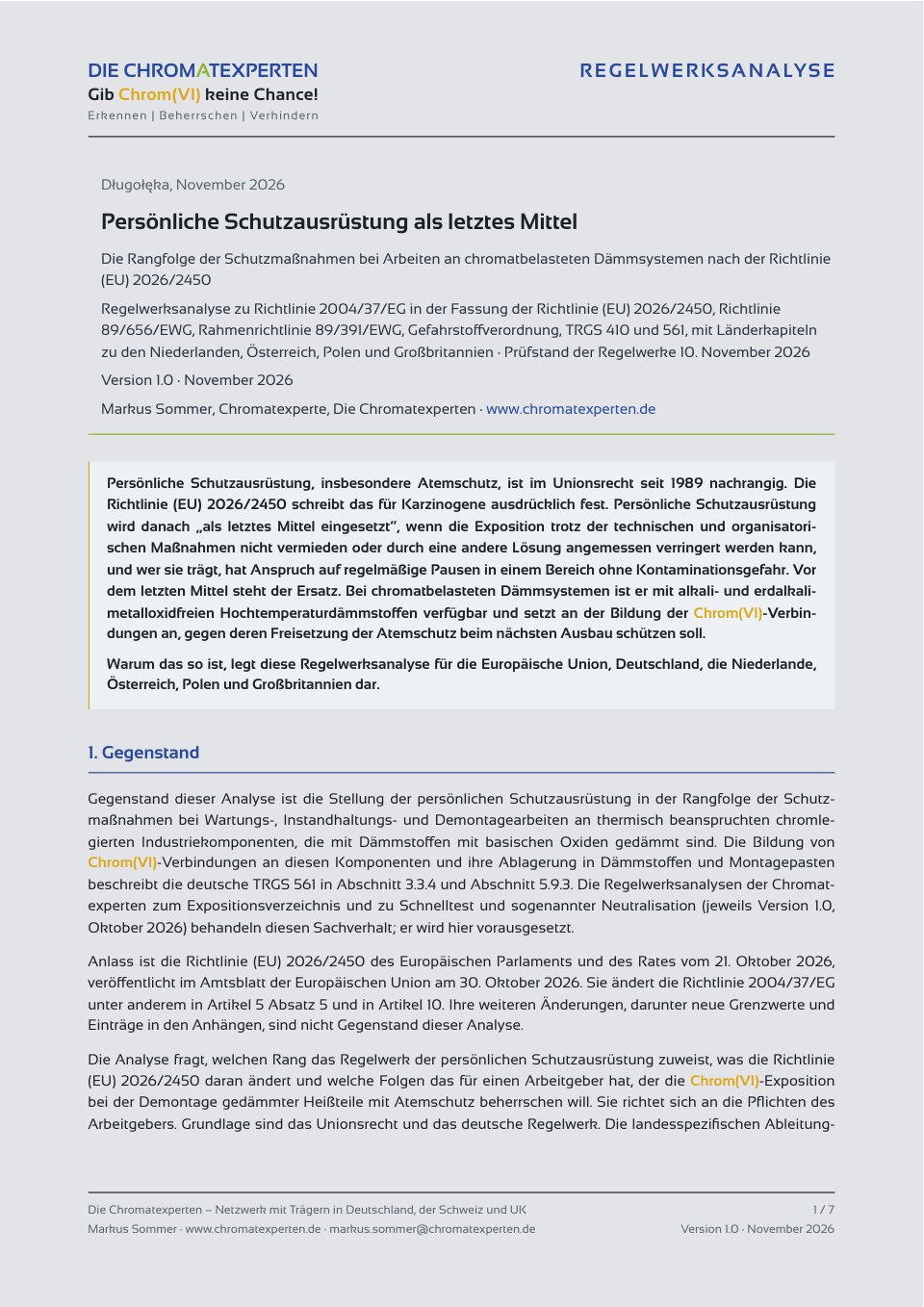
The hierarchy of protective measures for work on chromate-contaminated insulation systems under Directive (EU) 2026/2450, with country chapters on Germany, the Netherlands, Austria, Poland and Great Britain. German edition, 7 pages.
Download PDF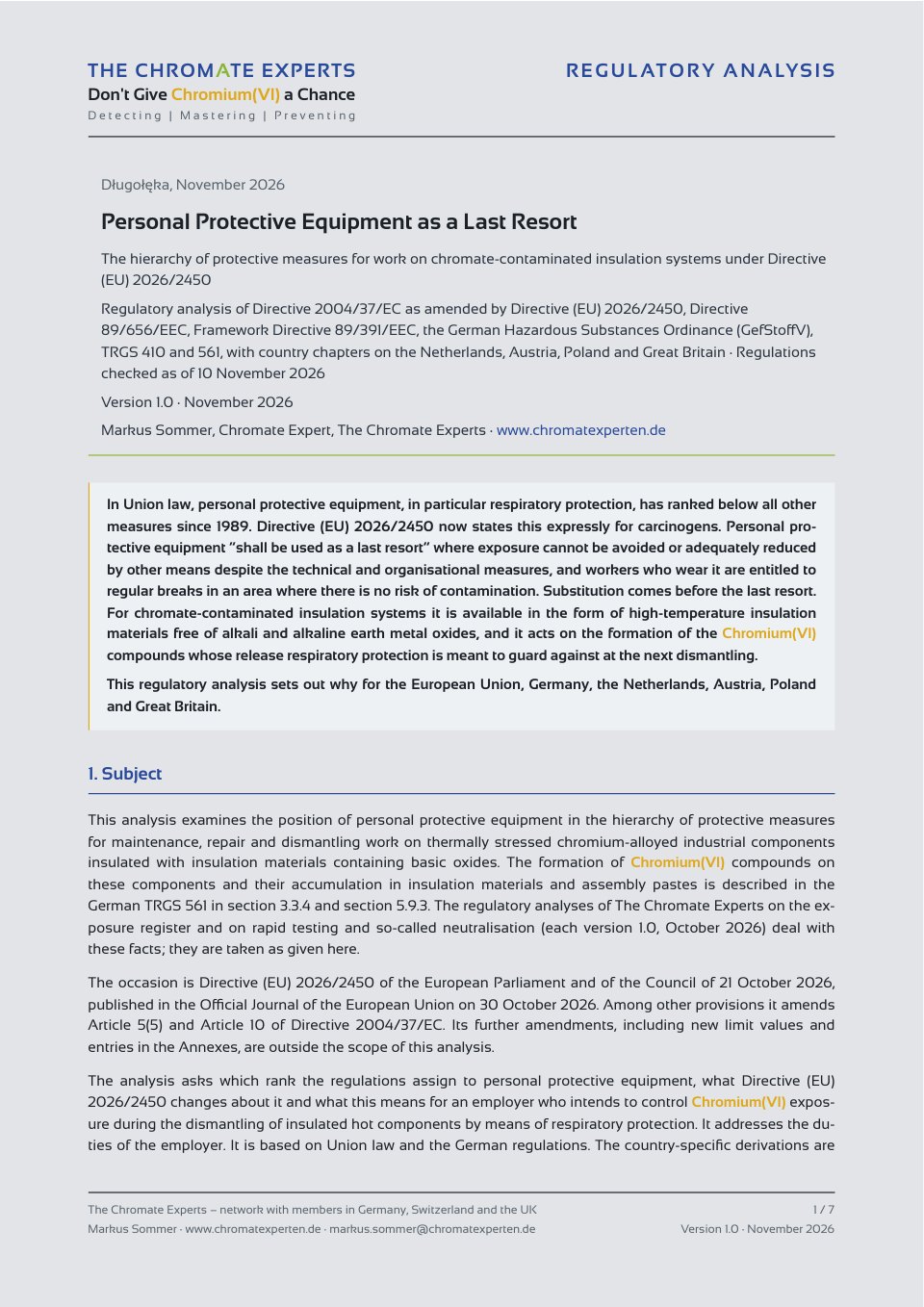
The hierarchy of protective measures for work on chromate-contaminated insulation systems under Directive (EU) 2026/2450, with country chapters on Germany, the Netherlands, Austria, Poland and Great Britain. English edition, 7 pages.
Download PDF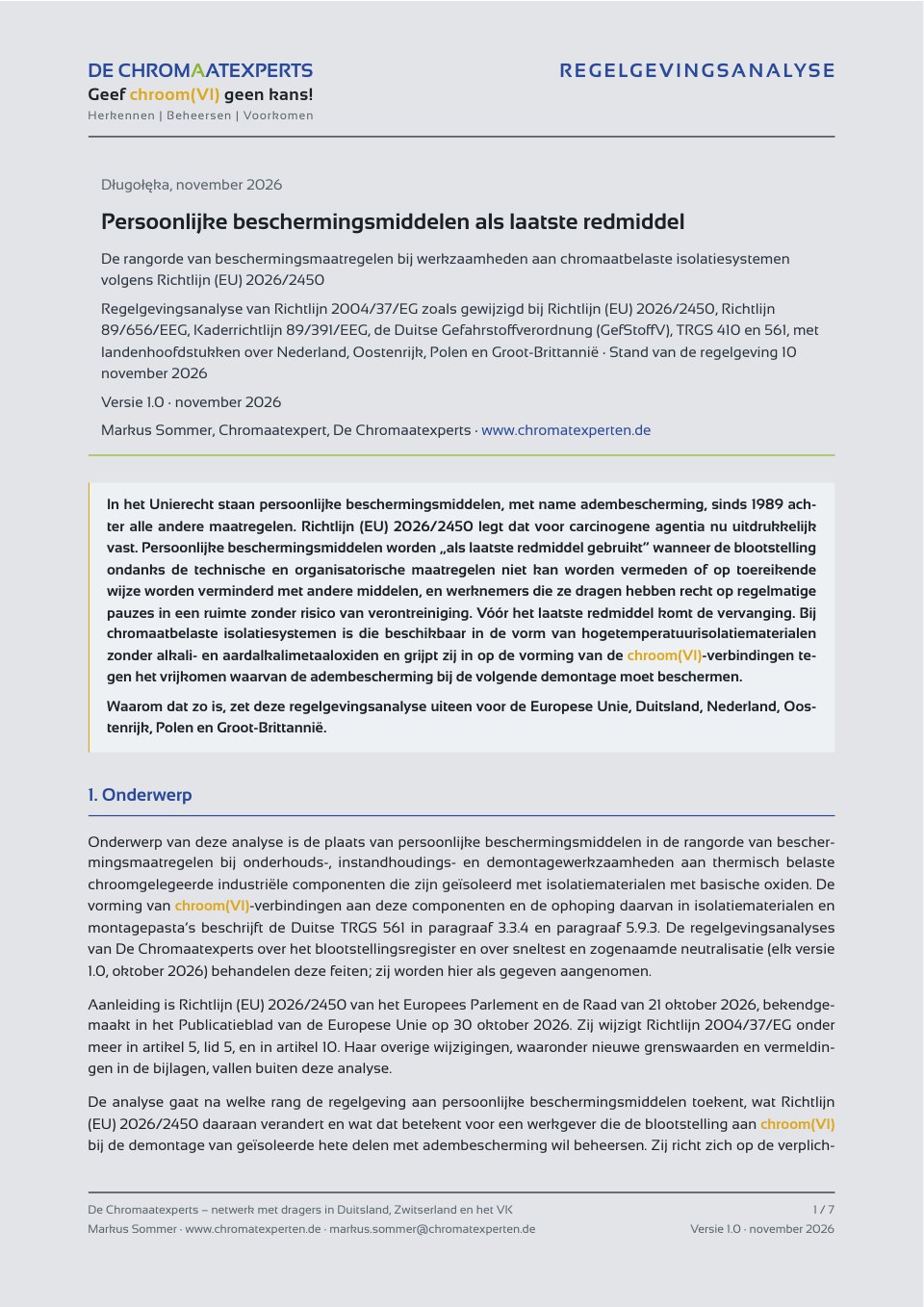
The hierarchy of protective measures for work on chromate-contaminated insulation systems under Directive (EU) 2026/2450, with country chapters on Germany, the Netherlands, Austria, Poland and Great Britain. Dutch edition, 7 pages.
Download PDF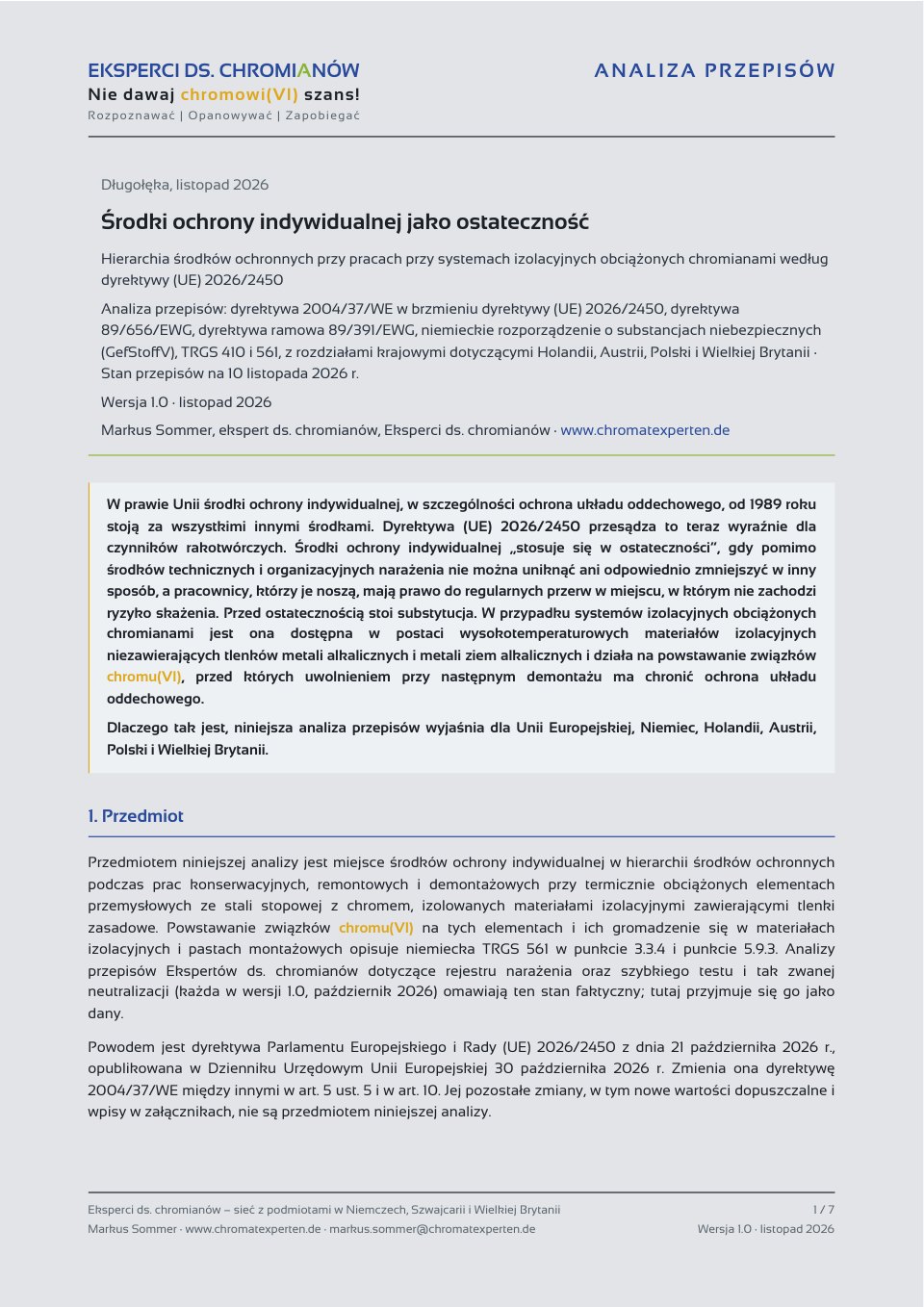
The hierarchy of protective measures for work on chromate-contaminated insulation systems under Directive (EU) 2026/2450, with country chapters on Germany, the Netherlands, Austria, Poland and Great Britain. Polish edition, 7 pages.
Download PDFOn 54 pages, all known decision bases for the risk assessment of work with carcinogenic, skin-absorbable and environmentally hazardous chromium(VI) compounds are explained and assessed under the rules applicable to occupational and environmental protection in Germany. Eight-page summary.
Manufacturers of engines, generating sets, insulation and mineral wool have taken up the issue in technical information, service notices and safety instructions. These notices describe findings on plants in operation, some with photographs from the field.
Chromium compounds in refractory, insulation and textile products can be converted to chromium(VI) in operation; during removal the dust carries the chromium(VI). The 1994 version extends the scope to “plastics, insulation, and textiles”.
Cr(VI) residue on exhaust system components, exhaust insulation box sheets and turbocharger parts. Calcium-containing assembly paste or calcium-based insulation, above 400 °C, chromium steel in contact. Wipe test kits before work begins.
Yellow residues on exhaust systems and exhaust insulation; independent laboratory tests confirmed Cr(VI).
Own analyses found Cr(VI) on engine components that had been in service; calcium chromate named expressly. Chromium steels, calcium-containing insulation or assembly pastes, oxygen, above 300 °C.
Confirms calcium oxide content in its own insulation materials. Chromium-alloyed steel, alkali and alkaline earth oxides, especially CaO, oxygen, above 350 °C.
More than 18 per cent alkali and alkaline earth oxides; Cr(VI) on stainless steel and mineral wool described.
On insulated stainless steel exhaust systems at elevated temperatures, reactions between stainless steel and common insulation materials can form Cr(VI).
Source: The Overlooked Ingredient, expert analysis V1.11, section 16