
Chromium(VI) in incineration ash: two decontamination jobs in Warsaw and Krakow

Incineration ash from waste incineration plants contains chromium(VI) compounds. They form wherever chromium-containing steel, basic oxides, oxygen and temperature come together, and after cooling they are present as chromate-containing dust that is released and carried over during maintenance, overhaul and cleaning. Two jobs in August and September 2026 in Poland show what this looks like during the overhaul of incineration furnaces and which protection and cleaning regime follows from it.

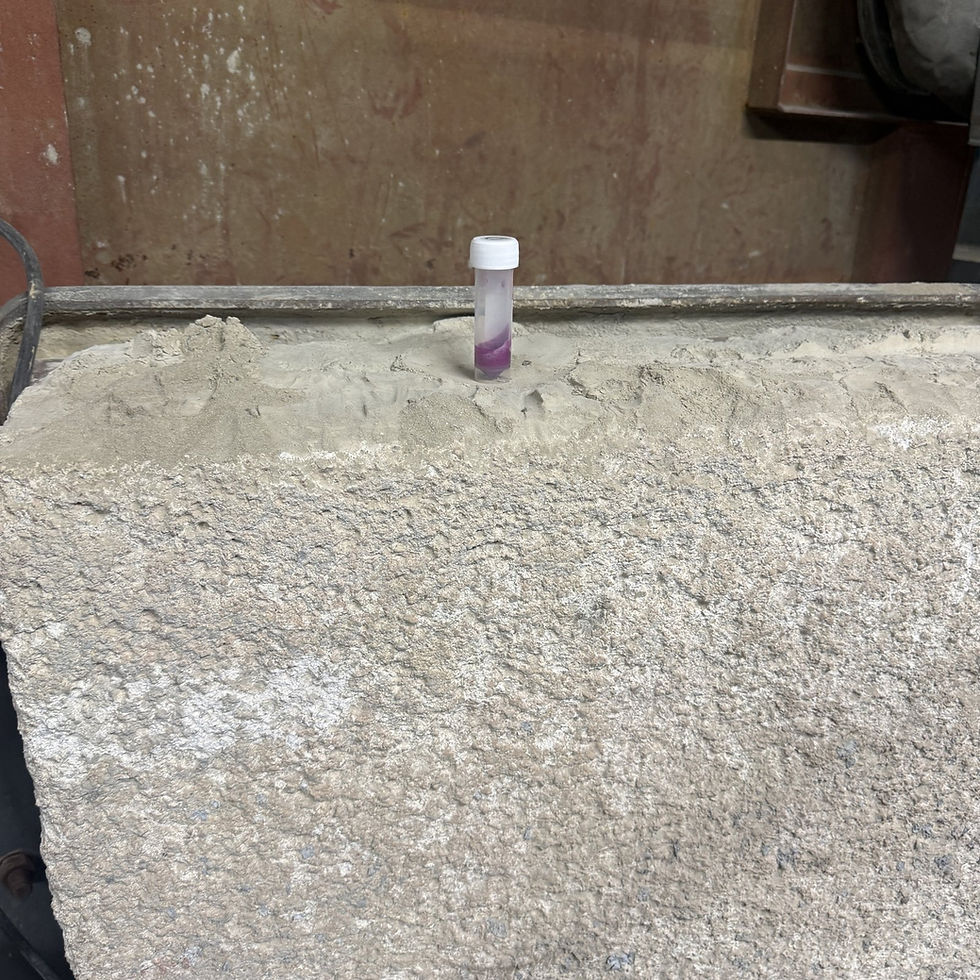
In Warsaw, before the overhaul of two incineration furnaces, the furnace interiors and doors were checked with chromium(VI) quick tests. The samples from the door and the fly ash turned purple. Chromate-containing dust lay on all surfaces, on door frames, inspection windows and the tops of the doors, and on the scaffolding inside the furnace.

In Krakow, the two incineration furnaces of a waste incineration plant were decontaminated on two dates. Wipe and floor samples on the checker plates of the scaffolding and at the furnace edge confirmed chromate-containing ash. The work had two goals: to prevent the ash from being carried over into adjacent, unprotected work areas, and to convert the chromium(VI) compounds in the ash to chromium(III) compounds by redox reduction. This lowers the hazard potential significantly; it does not eliminate it completely.

Both jobs followed the same procedure. Walls, scaffold parts and floor were wetted over the whole area by aerosol spraying with an aqueous redox solution (KavarClean®), from top to bottom and from back to front, so that the solution gets its reaction time and the dust is bound. The bound dust was then swept up with low dust generation, collected in sealable bags and wetted again before and after being carried out. Dust pockets on the tops of the doors and at the inspection windows were removed with simultaneous wetting. In Krakow, the service life of the dust filters was exhausted after the wetting, so the work had to be interrupted.

The Kavarmat® crew worked in category 5/6 protective suits with taped seams, two pairs of nitrile gloves, safety helmets and full-face masks with P3 filters. Chromium(VI) compounds are water-soluble and absorbed through the skin; they dissolve in sweat and are taken up through the facial skin, which is why half masks are not sufficient. Exit was in two stages: spraying down the suits with the reduction solution before leaving the furnace and again outside on an absorbent mat. Helmets and full-face masks were chromate-reduced for further use.
In both cases the work area was zoned and cordoned off. Personal air measurements inside the furnace alone are not sufficient for the risk assessment. Because of the ash's potential for turbulence and carry-over, the entire surroundings have to be assessed, including the routes by which tools, clothing and removed parts leave the work area. What the analysis "The Overlooked Ingredient" describes for insulation materials on chromium-alloyed hot parts applies to incineration ash in the same way: no chromate is present as delivered, it forms during operation and is released during maintenance.
Comments